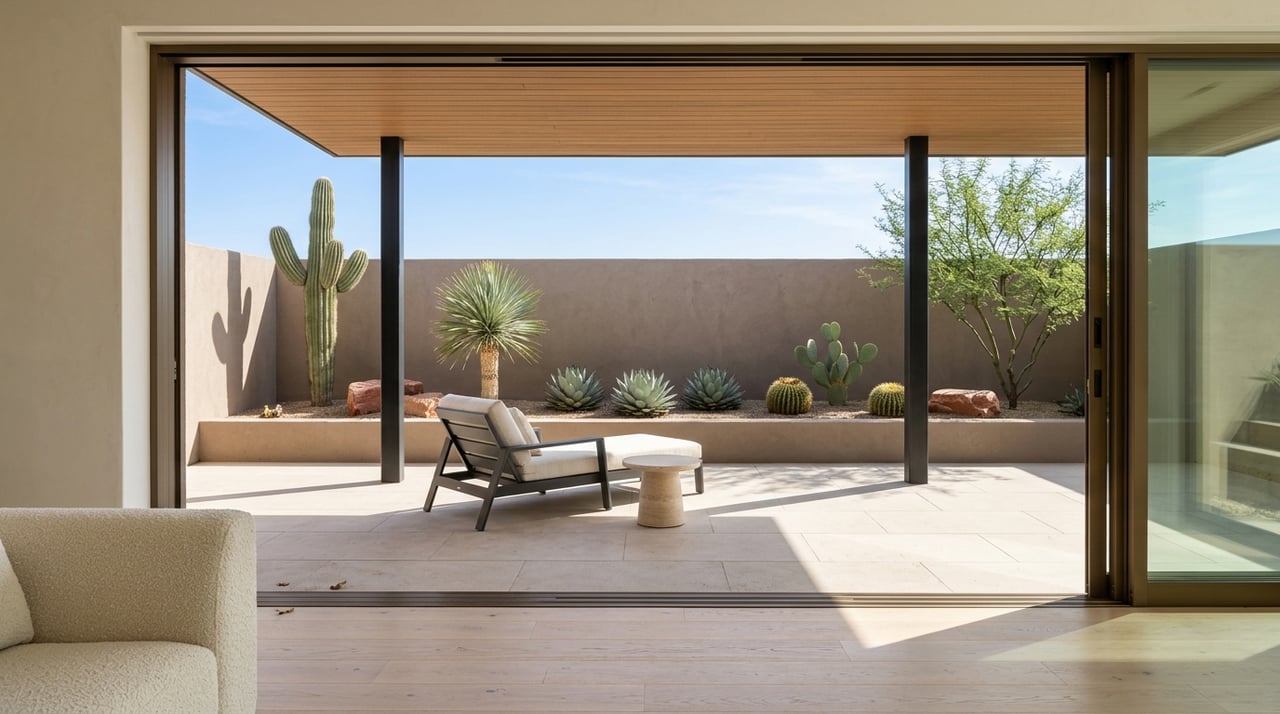
How Scottsdale Owners Can Trade Up To A Sedona View Home
May 21, 2026
May 21, 2026
Thinking about turning Scottsdale equity into a Sedona view home? You are not alone, and you are not imagining the appeal. A move like this can turn one high-value Arizona property into a home with red rock views, a different pace, and a lifestyle shift that feels meaningful. The key is making the trade-up plan work on paper, not just in your head. Let’s dive in.
Selling in Scottsdale and buying in Sedona can work well, but it usually does not happen as a perfect one-week swap. Current market data shows both markets moving at a measured pace, with many homes taking around two months or more depending on price point and property type. That means your timing, financing, and contract terms matter just as much as the homes themselves.
In Scottsdale, recent snapshots show a balanced market with meaningful inventory and room for negotiation. Realtor.com reports about 3,947 homes for sale, a median listing price near $1.06 million, 65 days on market, and a 97% sale-to-list ratio in March 2026. Phoenix REALTORS’ April 2026 update also shows a slower, more negotiable environment, with single-family median sales at $1,240,500, 78 days on market, and 5.3 months of inventory.
Sedona is smaller and more segmented. Realtor.com shows 443 active homes, a median listing price of $832,499, and 71 days on market, while a local March 2026 update reported 4.53 months of supply, 86 days on market, and a 97.4% sale-to-list ratio. In plain terms, Sedona still has limited supply, but buyers are being selective and sellers are not getting a blank check.
If you have owned in Scottsdale for a while, you may be sitting on substantial equity. That equity can become your down payment, your cash buffer, or the tool that helps you reach a higher-quality view property in Sedona. But you need to know how much of that equity is actually usable after sale costs, loan payoff, and possible taxes.
For some owners, the federal home-sale exclusion may affect the final number. IRS Publication 523 says qualifying taxpayers may exclude up to $250,000 of gain, or up to $500,000 if married filing jointly, if ownership and use tests are met. That does not replace tax advice, but it does show why your net proceeds should be reviewed early rather than guessed at.
A clear estimate of your Scottsdale sale proceeds helps answer the most important question: what can you comfortably buy in Sedona without overreaching? That answer is often more nuanced than the headline prices suggest.
A Sedona view home does not come with one standard price tag. The market varies sharply by area, lot orientation, view corridor, home style, and whether the property sits in an HOA or no-HOA setting. Treating Sedona as one price bucket can lead to missed opportunities or unrealistic expectations.
Recent snapshot data shows how wide the spread can be. Realtor.com reports zip code 86336 around $1.457 million, while 86351 is closer to $870,500. That range matters because your Scottsdale home may trade into a larger home, a better view, a lower-maintenance setup, or a more distinctive luxury property depending on where you focus.
The same is true on the Scottsdale side. Market snapshots show meaningful differences between areas like Old Town, North Scottsdale, and higher-end zip codes such as 85262. In other words, this is rarely a simple move from one city to another. It is usually a move from one micro-market and lifestyle fit to another.
Trading up does not always mean spending far more. Sometimes it means using your Scottsdale equity to buy a Sedona home with stronger visual impact, more privacy, or a setting that better fits how you want to live now. For one buyer, that may be a dramatic red rock backdrop. For another, it may be a lock-and-leave luxury home with less maintenance.
You may also find that some Sedona view homes are priced below what you would expect compared with upper-end Scottsdale product, while others command a premium because the lot or orientation is difficult to replicate. The point is to compare value by property type and setting, not just by square footage.
The biggest mistake in a Scottsdale-to-Sedona move is assuming both closings will line up neatly. Current market pace does not support that as the default plan. A more realistic expectation is several weeks to a few months from listing in Scottsdale to closing on your Sedona purchase, especially if you want to avoid carrying two homes for long.
That does not mean the move is difficult. It means you need a plan with buffers. You may list first, secure a buyer, and then begin Sedona offer activity more aggressively. Or you may start shopping earlier so you understand what price range and home style are truly worth acting on when your Scottsdale sale gains traction.
When you are selling one home and buying another, contract structure can make or break the experience. Several common contingency tools are directly relevant to a trade-up move. The most useful ones often include a home sale contingency, a home close contingency, a kick-out clause, or a rent-back arrangement.
Here is what those can mean in practice:
These tools can reduce pressure, but they also affect how competitive your offer looks. In a smaller market like Sedona, sellers often prefer clarity and strong buyer qualifications.
Mortgage rates still shape this move in a real way. Freddie Mac reported the average 30-year fixed-rate mortgage at 6.36% and the 15-year fixed at 5.71% as of May 14, 2026. If you are moving up in price, or simply trying to keep your monthly payment where you want it, rate sensitivity should be part of your planning from day one.
A lender pre-approval is especially important. Realtor.com’s Sedona guidance notes that a pre-approval letter can strengthen your offer, and that carries extra weight when you are also coordinating another sale. Sellers want confidence that your financing is organized and your timing is real.
If you want to buy before your Scottsdale sale closes, you may need stronger liquidity or short-term gap financing. Bridge loans are one possible option, but availability varies by lender, and they are not a one-size-fits-all solution. The right path depends on your cash reserves, lender approval, and the seller’s willingness to work with contingencies.
Even a well-planned purchase has timing limits near the finish line. Lenders are required to deliver the Closing Disclosure at least three business days before closing. That means there is a built-in minimum window at the end of the transaction, even when everything is otherwise on track.
This is why smart move-up planning includes room for final underwriting, document review, title work, and funding. If you are trying to stack two closings tightly, small delays can create larger stress fast. A little extra time can protect both your leverage and your peace of mind.
If you are serious about trading up to a Sedona view home, start with sequence, not emotion. It is easy to fall in love with a view. It is smarter to know your numbers, timing options, and contract flexibility before you write an offer.
A practical approach often looks like this:
This kind of planning is where dual-market experience matters. Scottsdale and Sedona may both be Arizona luxury markets, but they behave differently, and each property can carry its own negotiation story.
If you want a clear, candid plan for selling in Scottsdale and buying in Sedona, Kris Anderson- ILoveSedonaRealEstate can help you map the timing, pricing, and strategy with the level of detail a move like this deserves.





At ILoveSedonaRealEstate, we’re committed to making every step of your real estate experience seamless and rewarding. Contact us today to discover how our local expertise and tailored service can help you achieve your real estate goals.